

- House Plant Sitting
- July 15, 2026
- News
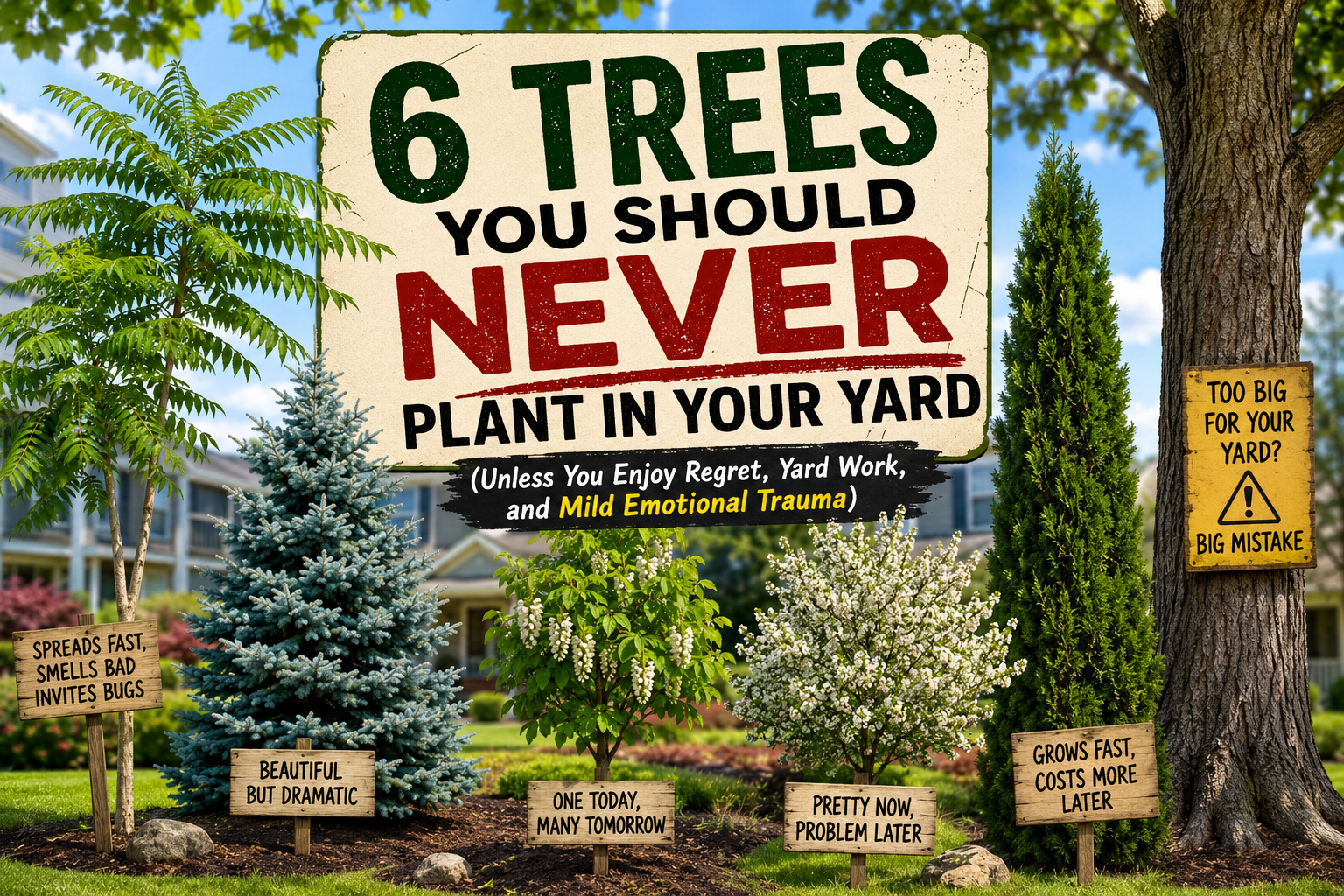
6 Trees You Should Never Plant in Your Yard
6 Trees You Should Never Plant in Your Yard Unless You Enjoy Regret, Yard Work, and Mild Emotional Trauma
Planting a tree feels like one of the most wholesome activities a human being can do. You dig a hole, place a tiny sapling into the earth, and pat the soil around it while imagining future generations gathering beneath its majestic branches, perhaps while drinking lemonade and complimenting your landscaping skills. It is a beautiful vision. Unfortunately, some trees have other plans.
Some trees grow too fast. Some smell like something died inside a gym locker. Some spread across your property as if they are attempting to establish their own independent nation. Others wait patiently for ten years, earning your trust, only to split in half during the first moderately enthusiastic thunderstorm. This is why choosing a tree for your yard is not simply about finding something pretty at the garden center and saying, “That one looks nice,” which is also how many people accidentally buy exercise equipment they will later use exclusively to hang laundry.
Trees are long-term relationships. Unlike that impulse purchase of a ceramic frog wearing sunglasses, you cannot easily remove a mature tree once it has settled in, made itself comfortable, and begun referring to your yard as “our property.” Many homeowners discover this the hard way when a tree that looked adorable at four feet tall becomes a forty-foot nightmare with roots invading sidewalks, branches attacking roofs, and leaves reproducing at a rate that suggests they are receiving military support.
The best trees for a yard are usually low-maintenance, well-adapted to the local climate, and polite enough not to destroy the driveway. Native trees are often excellent choices because they support local birds, pollinators, and wildlife while generally requiring less babysitting than plants dragged into climates where they clearly do not want to live. But some trees should make you pause, put down the shovel, and slowly back away before your future self has to call a tree removal company while making the face people make when they see the estimate.
To help you avoid expensive landscaping regret, here are six trees experts say you should think very carefully about before planting in your yard.
1. Tree of Heaven: The Invasive Tree That Will Try to Conquer Your Entire Yard
The Tree of Heaven may hold the all-time record for Most Misleading Plant Name. Calling this species the Tree of Heaven is a little like naming a mosquito “Butterfly of Happiness.” At first glance, it seems appealing. It grows quickly, tolerates poor soil, and appears almost impossible to kill. Garden centers sometimes market these qualities as strengths, but they are not strengths. They are warnings wearing a little price tag.
The Tree of Heaven, also known as Ailanthus altissima, is considered invasive throughout much of the United States. It spreads aggressively through both seeds and underground roots, which means that once it gets comfortable, it may begin behaving less like a tree and more like a real estate developer with unlimited funding. Cut one down and you may end up with several new trees popping up across your lawn as if the original tree called for reinforcements before dying.
Homeowners frequently report finding new shoots in flower beds, vegetable gardens, lawns, sidewalks, and random areas of the yard where no plant was invited. This is the kind of tree that does not understand boundaries, personal space, or the basic social contract between homeowner and landscaping.
As if its aggressive behavior were not enough, Tree of Heaven also emits a smell that many people find deeply unpleasant. This is not the light, romantic fragrance you imagine drifting through the yard on a spring evening while someone plays acoustic guitar. This is more of a “what is that and should we call someone?” situation. To make matters worse, Tree of Heaven is a favorite host of the spotted lanternfly, a destructive invasive pest whose main hobby appears to be making gardeners and farmers unhappy.
Unless you are reclaiming an abandoned industrial site where absolutely nothing else will grow, there are very few good reasons to plant Tree of Heaven. Your future self, your neighbors, your flower beds, and possibly local agriculture will thank you for walking away.
2. Colorado Blue Spruce: The Gorgeous Evergreen That May Secretly Hate Your Climate
The Colorado blue spruce is undeniably gorgeous. With its striking silvery-blue needles and classic Christmas-tree shape, it is easy to understand why homeowners fall in love with it at the nursery. It looks elegant, sturdy, and festive, like the kind of tree that would appear in a holiday movie where everyone learns the true meaning of family and nobody ever has to deal with fungal disease.
The problem is geography. Colorado blue spruce evolved in the Rocky Mountains, and the word “Colorado” is a clue that many homeowners, through no fault of their own, choose to ignore. Trees generally appreciate it when we pay attention to where they are from. If a tree is native to cool, dry mountain regions, it may not be thrilled when you plant it in a humid suburban yard where the air feels like soup and the mosquitoes have voting rights.
Outside its ideal climate, especially in humid regions across the Midwest, South, and East Coast, Colorado blue spruce often struggles. Homeowners frequently plant blue spruce expecting decades of year-round color. Instead, they get browning needles, thinning branches, disease treatments, and the particular emotional journey of standing in the yard staring at a tree while Googling “why is my spruce sad?”
Common problems include needle cast diseases, cankers, fungal issues, and gradual decline. You may find yourself spending hundreds or even thousands of dollars trying to keep the tree alive, only to remove it years later anyway. It is a little like adopting a snow leopard and then wondering why it seems unhappy living in your Florida backyard.
If you live outside the Mountain West, there are usually better evergreen trees adapted to your climate. Native or regionally appropriate evergreens often require less maintenance, resist local diseases better, and support birds and wildlife without needing constant intervention. Your yard should not require the emotional support of a plant hospital.
3. Black Locust or False Acacia: The Fast-Growing Tree That Does Not Understand Property Lines
Black locust, also known as false acacia, is one of those trees that seems charming at first. It grows quickly, produces lovely clusters of fragrant white flowers, attracts bees, and has durable wood. On paper, this sounds wonderful. In fact, if trees had dating profiles, black locust would probably describe itself as “outdoorsy, hardworking, great with pollinators, and looking for something serious.”
Unfortunately, black locust is very serious. Too serious. This tree spreads aggressively through root suckers, sending up new shoots throughout the surrounding area. One tree can eventually become many trees, and many trees can become the kind of situation where you stand in your yard and say, “Wait, wasn’t there only one of these last year?”
What starts as a charming addition to your landscape can turn into a full-scale botanical uprising. Black locust has a habit of moving into open areas and behaving as though it recently purchased the deed. In many parts of the United States, it is considered invasive because it can crowd out native plants and take over disturbed land faster than you can say, “Maybe we should have planted a dogwood.”
There are situations where black locust can be useful. People involved in permaculture, agroforestry, or land restoration may value it for pollinators, nitrogen fixation, and durable timber. But that is a very different thing from planting it next to your patio because the flowers looked pretty. This is not a casual backyard tree for someone whose landscaping plan is mostly “I hope this survives.”
For the average homeowner, black locust is often more trouble than it is worth. Bees may love it, and yes, the flowers are beautiful, but beauty is less impressive when it comes with thirty surprise tree babies marching across your lawn like they are late for a meeting.
4. Bradford Pear Tree: America’s Most Regrettable Landscaping Decision
There was a time when Bradford pear trees seemed unstoppable. Developers planted them everywhere. Cities planted them. Homeowners planted them. Entire neighborhoods bloomed in synchronized clouds of white flowers every spring, and for a while, everybody thought this was wonderful. It was like America collectively looked at one ornamental tree and said, “Yes, this one. Put it everywhere.”
Then people got to know it.
The Bradford pear has become infamous for its weak branch structure. As the tree matures, its limbs often split apart during storms, heavy winds, snow, ice, or occasionally because it sensed you were having a peaceful weekend. Homeowners may care for a Bradford pear for ten years or more, only to wake up one morning and find half the tree lying across the driveway like it had a difficult night.
Sometimes the driveway gets off easy. Houses, cars, fences, sidewalks, and utility lines can all become victims of Bradford pear drama. The tree grows quickly, but that speed comes with structural problems, which is also true of many things assembled quickly, including discount furniture and certain emotional decisions made after 11 p.m.
And then there is the smell. Bradford pear flowers are visually impressive in spring, but their fragrance has been described in ways that polite gardening publications try very hard to avoid. Let us simply say that if “pleasant spring aroma” were a job requirement, Bradford pear would not make it past the first interview.
Bradford pears have also become invasive in many areas, spreading into natural spaces and crowding out native plants. Several states now discourage or restrict planting them, which should tell you something. When a tree becomes so problematic that entire states are basically saying, “Please stop,” it is time to listen.
The good news is that there are many better flowering trees for residential yards. Serviceberry, eastern redbud, flowering dogwood, and native crabapples can provide beautiful spring color without the structural disasters, invasive tendencies, and mysterious gym-sock fragrance. Your yard deserves romance, but not the kind that ends with storm cleanup and regret.
5. Leyland Cypress: The Fast-Growing Privacy Tree That Can Cost You Thousands
Homeowners love privacy. Garden centers know this. That is why Leyland cypress trees continue to sell by the thousands. The sales pitch is simple: “Want privacy? These grow incredibly fast!” And they do. Extremely fast. Suspiciously fast. The kind of fast that should make you ask more questions before putting twelve of them along the property line.
At first, Leyland cypress seems like a brilliant idea. You plant a neat row of small evergreens, and before long you have a soft green privacy screen blocking the neighbor’s trampoline, trash cans, or whatever mysterious activity is happening behind their shed. For a few years, you feel like a landscaping genius.
Then the trees keep growing. And growing. And growing.
Leyland cypress can quickly outgrow small and medium suburban yards. What begins as a tidy privacy hedge may eventually become a towering evergreen wall sixty feet tall and fifteen to twenty feet wide. At that point, you do not have a privacy screen so much as a green fortress with ambitions.
Rapid growth also comes with problems. Leyland cypress trees are vulnerable to stress-related diseases, pest issues, spider mites, cankers, root problems, and browning from the inside out. Their dense growth can reduce airflow, creating ideal conditions for trouble. Once sections begin to decline, they often do not recover well, which leaves homeowners with brown patches, dying trees, and a growing sense that the hedge is now in charge.
The worst part is the removal cost. An entire mature Leyland cypress hedge can be expensive to remove, especially if access is difficult or the trees have grown into one massive evergreen beast. Nothing ruins a Saturday quite like receiving a tree removal estimate that resembles the purchase price of a compact automobile.
If you need privacy, look for slower-growing, regionally appropriate trees or shrubs that fit your space and climate. A little patience is much cheaper than planting a fast-growing privacy screen that later requires heavy equipment and a financial support group.
6. Large Trees in Small Yards: The Costly Mistake That Can Damage Your Home
This final category may be the most important of all because even a wonderful tree can become a terrible choice when planted in the wrong place. Every year, homeowners install massive shade trees only a few feet from homes, driveways, sidewalks, septic systems, fences, or utility lines. At planting time, everything looks fine because the tree is small, cute, and standing there like it would never dream of damaging anything.
Twenty years later, the consequences arrive.
Roots lift concrete. Branches scrape roofs. Leaves clog gutters. Power companies begin leaving notes. Sidewalks buckle in ways that make guests walk carefully while pretending not to notice. The same tree that once seemed charming now requires pruning, maintenance, and tense conversations involving words like “foundation,” “liability,” and “how much is this going to cost?”
Tree placement matters just as much as tree selection. Before planting any tree, you need to know how tall it will become, how wide the canopy will spread, how aggressive the root system may be, and whether it will interfere with structures, pipes, sidewalks, driveways, or overhead power lines. This is not the fun part of gardening, but it is the part that prevents your yard from becoming a future insurance claim.
A tree that is perfect on a large rural property may be completely inappropriate in a small suburban yard. A massive shade tree can be glorious when it has enough room. Planted too close to the house, it becomes less “majestic landscape feature” and more “slow-motion structural negotiation.”
The old gardening saying remains true: right plant, right place. It is not particularly catchy, but neither is “Why is my driveway cracking in half?” Measure first, research mature size, and give trees the room they need. Your home, your sidewalk, and your bank account will appreciate your restraint.
How to Choose Low-Maintenance Trees That Will Not Make You Cry Later
If all this sounds discouraging, do not worry. There are plenty of outstanding trees for residential landscapes. The trick is choosing trees that fit your climate, your soil, your yard size, and your tolerance for future yard work. The best tree for your neighbor in Colorado may be a terrible tree for your yard in Florida, and the best shade tree for a five-acre property may be a very bad idea next to your driveway.
In general, look for trees that are native or well-adapted to your region, resistant to common local diseases, appropriate for the available space, and beneficial to birds, pollinators, and wildlife. Low-maintenance trees are not necessarily boring. Many native trees offer flowers, fall color, shade, wildlife value, and beauty without behaving like they are auditioning for a disaster documentary.
Before planting, consult your local extension office, a certified arborist, or a reputable nursery that actually understands your region. This small step can save years of frustration, expensive removal costs, and emotionally charged conversations with chainsaw professionals. It can also help you avoid planting something that looks cute now but will later treat your yard like a hostile takeover opportunity.
Trees should bring beauty, shade, wildlife, and joy to your yard. They should not bring invoices, invasive suckers, sidewalk damage, mystery smells, pest problems, or the sudden need to learn how much a stump grinder costs. Choose wisely, plant carefully, and remember that every tiny sapling at the garden center is either a future treasure or a future problem wearing leaves.
And definitely avoid the ones that come with botanical regret.
Share on