

- House Plant Sitting
- July 01, 2026
- News
One Man’s Search for Florida’s Last Wild Orchids
The Florida Orchid Hunter Trying to Save the Flowers Before They Disappear
Florida is famous for a lot of things: beaches, hurricanes, alligators, theme parks, mysterious roadside attractions, and people who wear flip-flops to places where flip-flops were never meant to go. But hidden behind the louder Florida is a quieter one, a stranger one, a Florida of hammocks, swamps, pine rocklands, mangroves, and rare flowers clinging to trees like tiny botanical secrets.
Among the most mysterious of these flowers are Florida’s native orchids.
Not the grocery store orchids sitting near the checkout line, looking elegant in a plastic sleeve and silently judging your snack choices. Wild Florida orchids are different. Some are tiny enough to miss even if you are standing right beside them. Some bloom high in trees. Some look like weeds when they are not flowering. Some vanish for decades, then reappear like they have been hiding from everyone on purpose.
And for most of his life, orchid conservationist Roger Hammer has been looking for them.
Hammer is one of those rare people who seems built for the job. He has spent decades hiking, canoeing, photographing, documenting, and protecting Florida’s native orchids and wildflowers. He is not the kind of person who says, “Nature is important,” and then goes back inside because the humidity is annoying. He is the kind of person who packs water, rations, a hammock, and a camera, then disappears into the swamp to find a flower smaller than your thumbnail.
In 1975, Hammer set out for Fakahatchee Strand Preserve State Park in search of one orchid in particular: Lepanthopsis melanantha, also known as the tiny orchid. Fakahatchee is one of the richest orchid habitats in Florida, home to about 50 native orchid species. That is nearly half of Florida’s orchid diversity, which is impressive until you remember that finding them often requires trudging through water, mud, heat, mosquitoes, and other Florida accessories.
Hammer had read about the tiny orchid, but few botanists had actually seen it in person. Its delicate burgundy-purple blooms were rare, hidden deep in the swamp, and extremely easy to miss. So naturally, he went looking for it.
After days of hiking, he had already seen about 30 orchid species. Then, while resting on a pop ash tree stump and eating a granola bar, he looked over his shoulder and there it was: the tiny orchid, quietly existing in the exact place where almost nobody would have noticed it.
That moment helped define a life.
Hammer went on to photograph nearly all of Florida’s remaining native orchid species. Florida has had roughly 110 native orchid species, but around a dozen have already disappeared from the state. Of the ones still remaining, many are listed as threatened or endangered. That makes Florida one of the great orchid states in the country, but also one of the places where orchids are most visibly in trouble.
And the trouble comes from every direction.
There is poaching. There is habitat destruction. There is climate change. There is sea-level rise, saltwater intrusion, stronger storms, urban heat, invasive plants, development, and people with weed trimmers who have no idea they may be cutting down something rare.
Florida’s orchids are not just pretty. They are fragile pieces of a very complicated living system.
Take the cowhorn orchid, Cyrtopodium punctatum. Hammer rediscovered it in Everglades National Park in 1988. This orchid, with its striking form and rarity, had already been depleted by overcollection and habitat destruction. Later, the plant he found was toppled by Hurricane Wilma in 2005. The cowhorn orchid is now listed as endangered in Florida, another reminder that even when a rare plant is found, that does not mean it is safe.
Then there is the ghost orchid, Dendrophylax lindenii, probably the most famous wild orchid in Florida. The ghost orchid looks like something invented by a poet who got lost in a swamp and started seeing spirits. Its pale white flower appears to float in the air because the plant has no traditional leaves and grows attached to trees. It is beautiful, strange, and highly vulnerable. Poachers have long targeted it, and conservationists have worked hard to keep its locations protected.
The ghost orchid is the celebrity orchid, the one that gets attention. But it is far from the only one in danger.
Hammer’s story includes orchids with names that sound like characters from an old adventure novel: Maxillaria parviflora, the purple tiger orchid; Pelexia adnata, known as Hachuela; Bletia patula, the Haitian pine pink orchid; Cranichis muscosa; Eulophia alta; and Vanilla dilloniana, a wild relative of the vanilla orchid that gives us vanilla flavoring.
Some of these plants are so rare that rediscovering them can feel almost unbelievable. The Haitian pine pink orchid, for example, had gone unseen for 58 years before being found again in Everglades National Park. Cranichis muscosa was rediscovered after more than a century without a confirmed sighting in the Fakahatchee. Imagine losing your keys for 101 years and then finding them in a swamp. Now imagine the keys are an orchid.
That is part of what makes orchid conservation so difficult. Orchids do not bloom on command. Many are easy to overlook when they are not flowering. Some seeds can lie dormant for long periods before germinating. A survey can miss them simply because they are not in bloom that week, or because they look like grass, or because the person walking by is too busy trying not to sink into mud.
This is why people like Hammer matter.
He has the eye for it. He knows where to look, when to look, and what a rare orchid might resemble when it is not putting on a floral performance. To most people, a patch of green near an electrical box might look like nothing. To Hammer, it might be a place where an orchid once grew before a mowing crew wiped it out.
That actually happened. In one place where Eulophia alta had been growing, the plant appeared to have been cleared away, likely mistaken for ordinary roadside growth. This is the quiet tragedy of rare plants: sometimes they are destroyed not by villains with chainsaws, but by ordinary maintenance work performed by people who simply do not know what is there.
But orchids also face a more dramatic human threat: collectors.
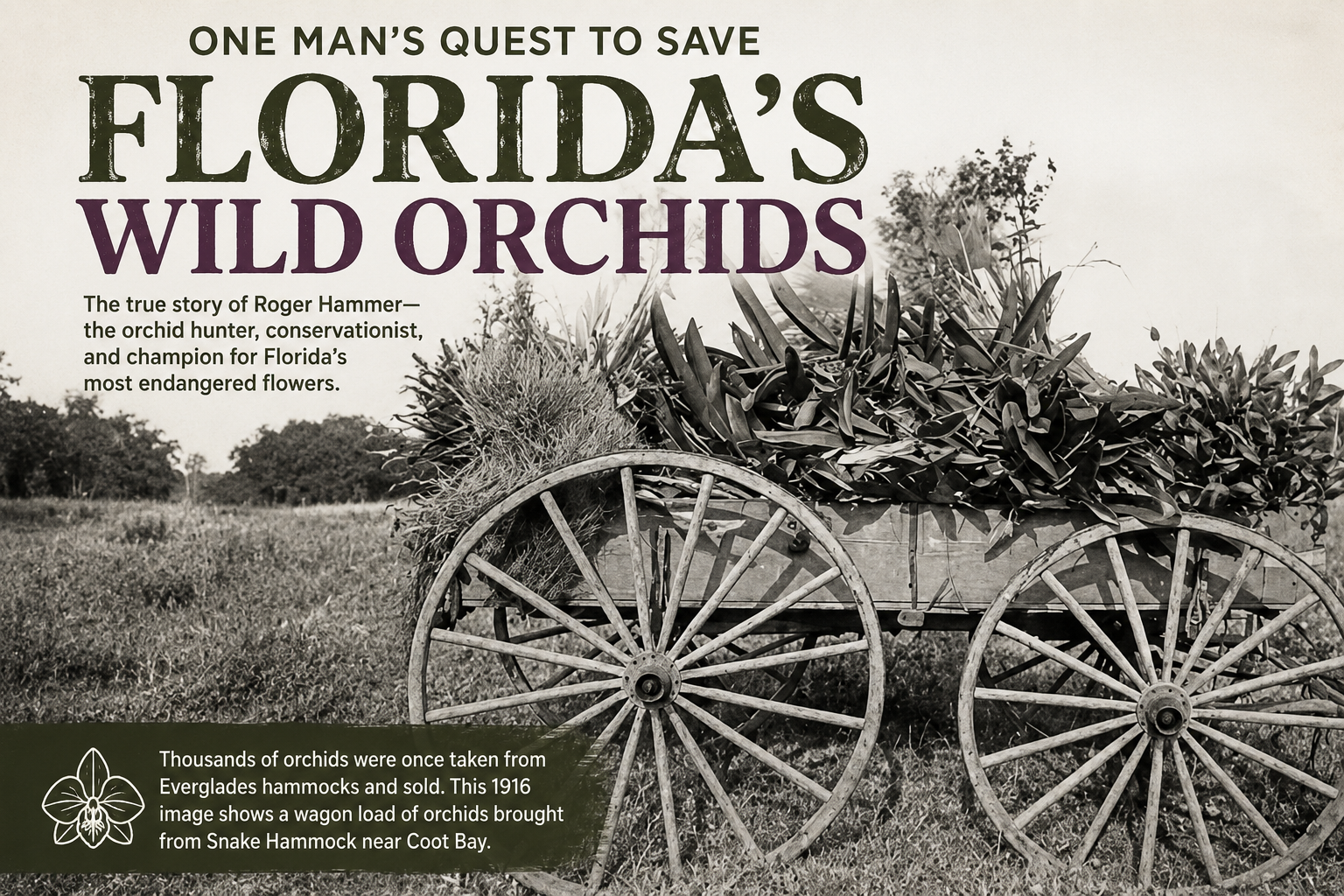
Orchid fever has a long history. In earlier eras, collectors raided wild places for rare orchids to sell in markets, especially in Europe. Florida’s Everglades and surrounding habitats were not spared. Wagons of orchids were taken from wild areas. Whole populations were reduced. Some species never recovered.
Even today, poaching remains a problem. Rare orchids attract a certain kind of plant obsession, the kind where admiration turns into possession. Someone sees a rare orchid and thinks, “I need that.” But removing an orchid from the wild is not saving it. Wild orchids depend on specific host trees, fungi, moisture, shade, air flow, and pollinators. Take one home and put it in a pot, and there is a good chance you have not adopted it. You have kidnapped it.
Hammer’s approach is the opposite.
After Hurricane Andrew devastated South Florida in 1992, fallen trees left orchids scattered on the ground. Some people saw an opportunity to collect them. Hammer saw a rescue mission. He attached orchids back onto living trees, helping them survive where they belonged. His message was simple: if an orchid falls, put it back in the tree.
This is conservation with mud on its boots.
Hammer himself is part scientist, part explorer, part field guide, part old-school Florida character. He grew up in Cocoa Beach, served after being drafted during the Vietnam era, returned to Florida, and eventually found his direction through a $25 orchid book purchased at Fairchild Tropical Botanic Garden. That book, The Native Orchids of Florida by Dr. Carlyle A. Luer, became the spark. Hammer wanted to photograph every native orchid in Florida.
He did not have a fancy academic pedigree. His highest formal degree was from high school. But he became one of the people botanists, authors, students, and plant lovers turned to when they wanted to understand Florida’s native flora. Florida International University later awarded him an honorary doctorate of science for his contributions. There is even a plant named after him: Euphorbia hammeri.
Which is the sort of thing that sounds impossible until you realize Hammer has spent decades doing the kind of work that cannot be faked. He has paddled solo canoe trips across Florida. He has searched remote places. He has led wildflower walks. He has identified species, photographed rare plants, and helped people see Florida’s botanical world more clearly.
His own yard is practically a living museum. It holds tropical plants, rare species, birds, butterflies, cats, dogs, parakeets, and the kind of biodiversity that makes a normal lawn look deeply embarrassed. At one point, Hammer rediscovered the rare Florida atala butterfly on Virginia Key in 1979, helping spark efforts to bring the species back. On and around his property, birders and neighbors have recorded an extraordinary range of birds and butterflies.
And among the plants in his care is Vanilla dilloniana, a wild orchid relative of commercial vanilla. This species is now extinct in the wild in Florida, but Hammer grows it in his yard. He has even made his own vanilla extract from its pods, soaked in vodka. This is the kind of detail that makes you realize you are not dealing with an ordinary plant hobbyist. You are dealing with a man whose backyard may contain more ecological storylines than some state parks.
Still, the wild orchids outside his fence face a much harder future.
Habitat loss is one of the biggest threats. South Florida has changed dramatically over Hammer’s lifetime. Farms, forests, wetlands, and open land have been replaced by roads, subdivisions, and commercial development. The Redland, once more rural and agricultural, has seen increasing pressure from growth. Every new development can mean the loss of habitat for orchids, host trees, pollinators, and the strange little ecological relationships that make orchids possible.
Climate change makes everything worse.
Rising seas push saltwater into freshwater habitats. Stronger hurricanes knock down trees and reshape coastal areas. Heat waves stress plants and dry out environments. Urban heat islands trap warmth in developed areas, changing local conditions. Some orchids can tolerate drier, hotter conditions better than others, but many native species rely on moisture and humidity. Orchids like the ghost orchid may struggle as their freshwater habitats change and their host trees decline.
Coastal orchids are especially vulnerable. Storm surge, saltwater intrusion, and intensifying hurricanes can damage or destroy the trees and habitats they need. Species like the mule-ear orchid, which grow in coastal environments, may be adapted to storms, but not necessarily to storms becoming more frequent or intense.
Pollinators add another layer of complexity. Some orchids rely on particular insects. The native oil bee Centris errans, found in Miami’s pine rockland forests, pollinates the locust berry, Byrsonima lucida. Cowhorn orchids can trick those bees into pollinating them too. But pine rockland habitat has been reduced to a tiny fraction of its original range. When the habitat goes, the bee suffers. When the bee suffers, the plants that rely on it suffer too.
This is why saving orchids is not as simple as planting more orchids.
You have to protect the whole system.
That is also why Fairchild Tropical Botanic Garden’s Million Orchid Project is so important. The goal is to grow and reintroduce large numbers of native orchids into public spaces across South Florida. In labs, orchid seeds are germinated in containers before the young plants are moved to nurseries and eventually attached to trees or planted in suitable habitat. Students, schools, and community volunteers have played a major role, helping restore orchids while also learning that conservation is not something that only happens in remote wilderness. It can happen in cities, gardens, schools, parks, and neighborhoods.
The Million Orchid Project is hopeful because it does more than grow plants. It rebuilds a relationship between people and native species. It reminds South Floridians that orchids are not exotic decorations from somewhere else. They are part of Florida’s own natural heritage.
That matters because people protect what they notice.
And Hammer has spent a lifetime noticing.
He notices a rare orchid that looks like a plain plant when it is not blooming. He notices a lost population. He notices an invasive shoebutton ardisia, Ardisia elliptica, growing too close to rare native plants, and he yanks it out by the roots because that is one small thing he can do immediately. He notices the places where orchids used to be and the places where they might still be. He notices what most of us would drive past.
That is the heart of this story.
Florida’s native orchids are not disappearing because nobody loves flowers. They are disappearing because love without knowledge can become destructive, and because development, climate change, and neglect move faster than rare plants can adapt. Orchids are being loved to death by collectors, squeezed by development, and stressed by a changing climate.
But they are also being saved by people who know better.
People like Hammer. People at Fairchild. Students growing orchids in school programs. Volunteers helping reintroduce native species. Botanists documenting rare populations. Conservationists protecting habitats. Even ordinary plant lovers can help by not taking orchids from the wild, supporting native plant conservation, respecting protected areas, and learning the difference between admiring nature and possessing it.
Because the truth is, wild orchids do not need to be owned to be loved.
They need trees. They need wetlands. They need pollinators. They need shade and humidity and clean water. They need people to stop treating every rare beautiful thing as something that belongs in a pot.
Some of Florida’s orchids may never come back. A dozen or so have already been wiped out from the state. Others may be lost before most people ever learn their names. But some are still out there. Some are being restored. Some are waiting underground. Some are blooming quietly in places where only the most patient eyes will find them.
That is what keeps Hammer going.
Even now, in his late seventies, he continues searching. He hikes, bikes, paddles, checks old locations, follows leads, and goes back into the field because the next orchid may still be out there. Maybe it is a ghost orchid hanging pale and silent from a tree. Maybe it is a cowhorn orchid clinging to survival. Maybe it is a Haitian pine pink, unseen for decades. Maybe it is a species nobody expected to find again.
Or maybe it is something completely new.
That is the magic of Florida’s wild places. For all the damage done, for all the land lost, for all the orchids taken, mowed, flooded, or forgotten, the swamp still keeps some secrets.
And somewhere in the heat, mud, mosquitoes, and tangled green, there may still be a tiny orchid waiting for someone like Roger Hammer to turn his head at exactly the right moment and say, “There it is.”
Share on